Description
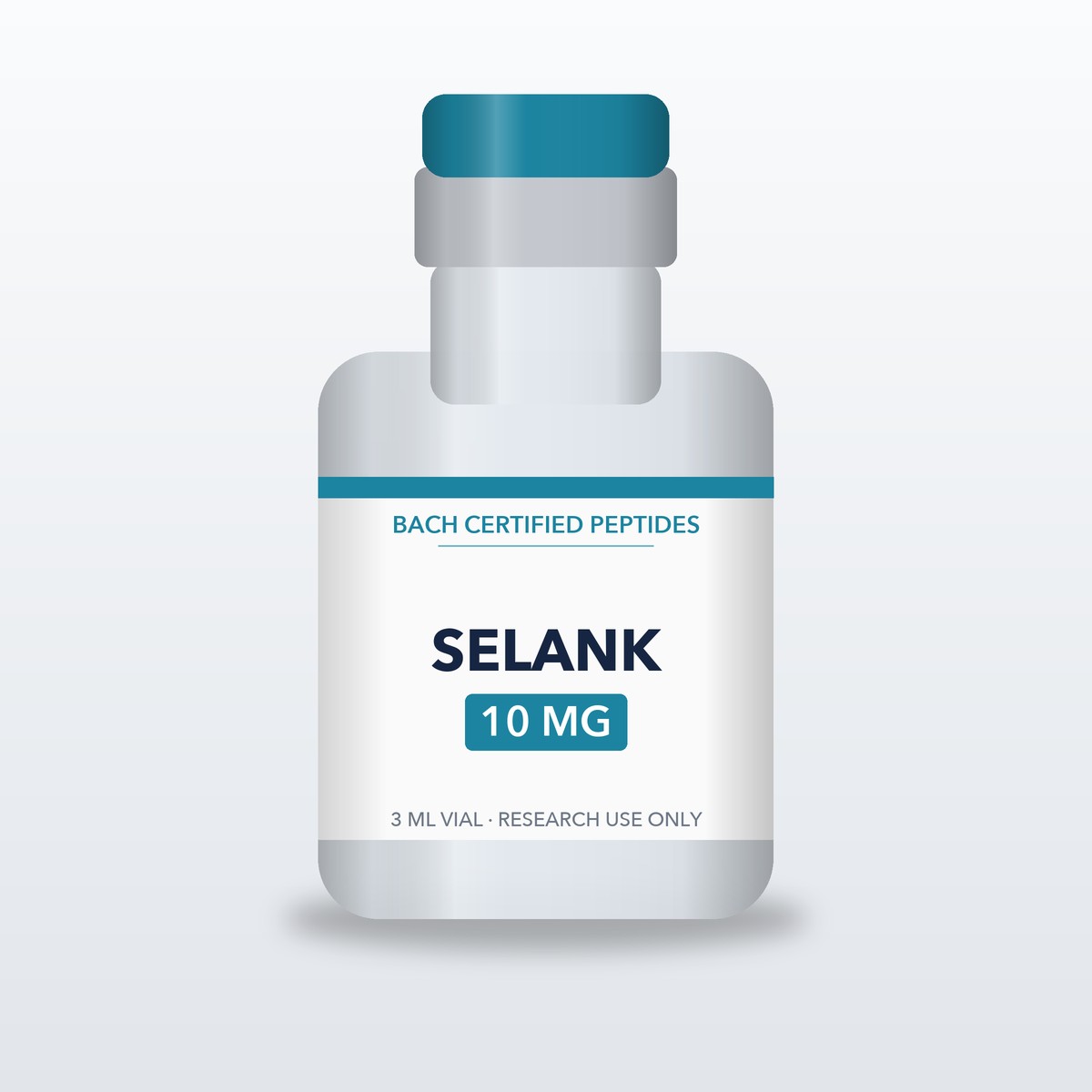
| SELANK 10 MG | |
|---|---|
| SKU | CP_SELANK_10MG_3ML_VIAL |
| CATEGORY | Research Compound |
| CAS | 129954-34-3 |
| VIAL SIZE | 3 mL |
| FORM | LYOPHILIZED POWDER (Acetate salt) |
| MOLECULAR WEIGHT | 751.87 g/mol |
| SEQUENCE | Thr-Lys-Pro-Arg-Pro-Gly-Pro |
| MOLECULAR FORMULA | C33H57N11O9 |
| ITEM ID | 77 |
Leonidovna et al. (2021) examined the influence of Selank on cytokine concentrations in white nonlinear rats subjected to a 20-day social-confrontation paradigm. Using enzyme-linked immunosorbent assay, the investigators measured serum levels of IL-1β, IL-6, IL-4, TGF-β1, and TNF-α. Stressed animals showed statistically significant elevations in IL-1β, IL-6, and TGF-β1 relative to intact controls. In the Selank-treated group, concentrations of IL-1β and IL-6 differed from the stress-only group, and IL-4 levels were closer to those of unstressed controls [1].
Selank peptide: a synthetic heptapeptide built on tuftsin
Selank is a synthetic peptide with seven amino acids: Thr-Lys-Pro-Arg-Pro-Gly-Pro. The first four residues, Thr-Lys-Pro-Arg, are tuftsin, a short fragment of the heavy chain of immunoglobulin G. The added Pro-Gly-Pro tail slows breakdown by peptidases, so the heptapeptide Selank lasts longer than tuftsin in tissue. It was developed at the Institute of Molecular Genetics of the Russian Academy of Sciences, the same group behind Semax. This vial holds 10 mg of Selank peptide as a lyophilized powder for laboratory research.
Mechanisms of action: GABA, enkephalins and BDNF
Researchers have proposed several mechanisms of action, and none fully explains the data. Volkova et al. (2016) found that Selank changed the expression of genes involved in GABA signaling in nerve cells [1]. That suggests it modulates GABA transmission rather than binding the benzodiazepine site directly. Kost et al. (2001) showed that Semax and Selank inhibit enkephalin degrading enzymes in human serum, which could prolong the action of the body’s own enkephalins [2]. In rats, intranasal administration of Selank raised BDNF expression in the hippocampus, a growth factor tied to synaptic plasticity [3]. Studies in rodents also report an influence on serotonin and noradrenaline metabolism in the central nervous system.
Selank in chronic stress models
Much of the animal work uses chronic stress models in rats. In these models, animals face weeks of mild, unpredictable stressors and develop anxiety-like behavior. Selank improved anxiety measures in these rats in several studies. Kozlovskaya’s group linked the effects to tuftsin-family peptides and the regulation of adaptive behavior under stress.
Combination therapy research: Selank and diazepam
Kasian et al. (2017) tested a combination therapy model in rats under unpredictable chronic mild stress [4]. They found that the peptide Selank enhances the anxiolytic effects of diazepam, a benzodiazepine, in these rats. The authors linked the finding to effects on the GABAergic system. This is rat data, and it says nothing about combining Selank with medications in people.
Cognitive enhancement, cognitive optimization and cognitive performance in rats
The interest in cognitive enhancement comes from rodent studies of learning and memory processes. Semenova et al. (2010) titled one paper “Experimental optimization of learning and memory processes by Selank” [5]. Vendors now use the phrase cognitive optimization, but in that work rats given Selank simply learned and kept tasks better under some conditions. A separate study compared Selank and tuftsin on serotonin metabolism in rats pretreated with PCPA, a drug that depletes serotonin. Animal findings on memory processes and cognitive function can’t stand in for cognitive performance data in people.
Human studies on anxiety disorders and mood regulation
Human studies are small and come almost entirely from Russia. In a paper on the efficacy and possible mechanisms of action of the new peptide anxiolytic Selank, Zozulia et al. (2008) studied patients with generalized anxiety disorders and neurasthenia [6]. They reported that Selank was about as effective at reducing anxiety as medazepam, a benzodiazepine. Patients on Selank also showed fewer signs of the sedation linked to benzodiazepine tranquilizers. Uchakina et al. (2008) reported immunomodulatory effects in patients with anxiety asthenic disorders [7]. Other rodent work looked at depression and mood disorders, including a comparative study of brain monoamines in two mouse strains.
These clinical studies had small groups, short follow-up and limited blinding. Their clinical effects have not been replicated in large trials outside Russia. Selank is registered as a medicine in Russia, but it is not FDA approved in the United States.
Selank nasal spray, mental health claims and regulatory status
In Russia, Selank is sold as a nasal spray or drops. Online, Selank peptide therapy is often marketed for mental health, mood regulation, sleep quality and concentration. Some sites call it a safer alternative to traditional medications for anxiety. Traditional medications have decades of research behind them, and Selank does not. For benzodiazepines, dependence is a primary concern; short Russian reports describe no tolerance over brief courses, but long-term data are missing. The reported side effects in the small trials were mild, such as nasal irritation and headache. Long-term safety is not well established, and questions about anxiety or any mental health treatment belong with a licensed clinician.
Anti aging and longevity medicine claims
Selank also appears in longevity medicine and anti aging marketing, often stacked with other nootropic peptides. Claims of improved quality of life, focus or memory in people go beyond the published data. The evidence for those claims is preclinical or comes from small trials of anxiety. Peptide therapy marketing often pins many potential effects on one compound, which the research doesn’t support.
Quality testing and storage
Certified Peptides manufactures in a cGMP facility in Texas. Every batch is tested by an ISO/IEC 17025 accredited US lab for purity (HPLC), quantity, identity (LC-MS), endotoxins, heavy metals and sterility. When you order this Selank peptide, match the QR-coded lot on the vial to its report in the COA Library, and see Lab Testing for the full panel. Keep vials sealed, cold and away from light.
Related research compounds include Semax 10MG, the Selank / Semax 10/10MG blend and Cerebrolysin. Like those, Selank is studied among synthetic peptides and other compounds that act on the nervous system.
Questions researchers ask
Why was Pro-Gly-Pro added to tuftsin?
Tuftsin is broken down in minutes by peptidases. The Pro-Gly-Pro tail resists those enzymes, so Selank stays intact longer in tissue and in human serum. Gly-Pro fragments are also being studied on their own for effects in the brain.
Does Selank bind the benzodiazepine site on GABA-A receptors?
Current data suggest it does not bind that site like diazepam does. Volkova et al. (2016) instead found changes in the expression of GABA-related genes after Selank exposure [1]. Researchers describe this as modulation of the GABA system, and the exact target is still unknown.
Why is Selank studied by intranasal administration?
Peptides given by mouth are mostly digested before they reach the blood. The nasal route offers a path to the central nervous system that may partly bypass the blood-brain barrier. Most rodent studies on BDNF and behavior used this route [3].
How does Selank differ from Semax?
Both come from the same Russian institute and both use a Pro-Gly-Pro tail. Semax is built on an ACTH fragment and is studied mainly for cognitive function and nerve injury. Selank is built on tuftsin and is studied mainly for anxiety and stress.
What would better human studies need?
They would need larger groups, placebo controls, longer follow-up and independent sites outside Russia. They should also report tolerance, withdrawal and interactions with other drugs. Until then, most Selank research analysis rests on rats and a few small trials.
Disclaimer
For laboratory research use only. Not for human or veterinary use. Not for consumption. This product is not a drug, food or cosmetic. Information on this page is for educational purposes, has not been evaluated by the FDA, and is not intended to diagnose, treat, cure or prevent any disease.
References
- Volkova A et al. “Selank Administration Affects the Expression of Some Genes Involved in GABAergic Neurotransmission.” Front Pharmacol. 2016;7:31. doi:10.3389/fphar.2016.00031
- Kost NV et al. “Semax and selank inhibit the enkephalin-degrading enzymes from human serum.” Bioorg Khim. 2001;27(3):180-183. PubMed
- Inozemtseva LS et al. “Intranasal administration of the peptide Selank regulates BDNF expression in the rat hippocampus in vivo.” Dokl Biol Sci. 2008;421:241-243. PubMed
- Kasian A et al. “Peptide Selank Enhances the Effect of Diazepam in Reducing Anxiety in Unpredictable Chronic Mild Stress Conditions in Rats.” Behav Neurol. 2017;2017:5091027. PubMed
- Semenova TP et al. “Experimental optimization of learning and memory processes by selank.” Eksp Klin Farmakol. 2010;73(8):2-5. PubMed
- Zozulia AA et al. “Efficacy and possible mechanisms of action of a new peptide anxiolytic selank in the therapy of generalized anxiety disorders and neurasthenia.” Zh Nevrol Psikhiatr Im S S Korsakova. 2008;108(4):38-48. PubMed
- Uchakina ON et al. “Immunomodulatory effects of selank in patients with anxiety-asthenic disorders.” Zh Nevrol Psikhiatr Im S S Korsakova. 2008;108(5):71-75. PubMed


Reviews
There are no reviews yet.