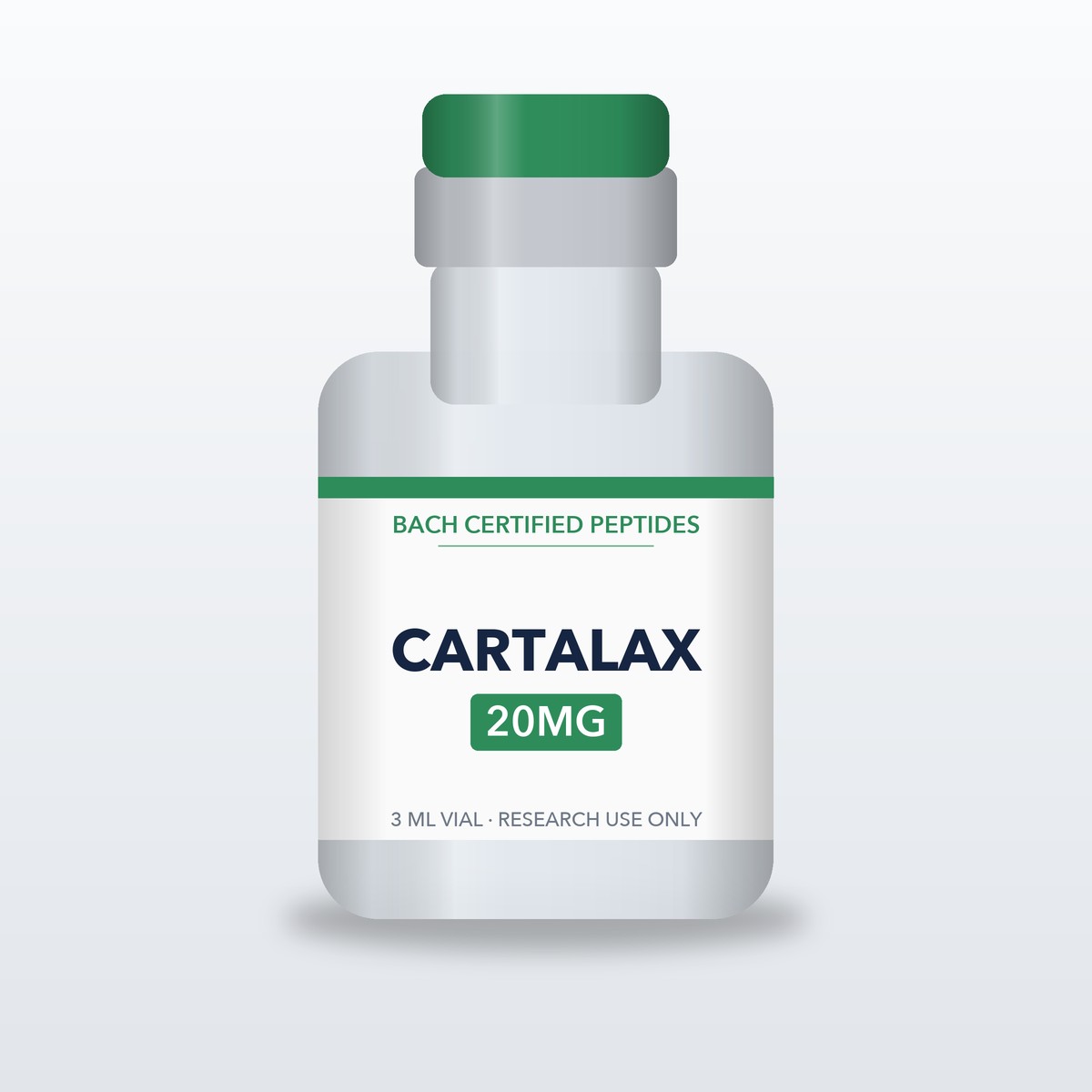
Description
| CARTALAX 20MG | |
|---|---|
| SKU | CP_CARTALAX_20MG_3ML_VIAL |
| CATEGORY | Bioregulator Peptide |
| CAS | 205640-90-0 |
| VIAL SIZE | 3 mL |
| FORM | LYOPHILIZED POWDER |
| MOLECULAR WEIGHT | 333.29 g/mol |
| SEQUENCE | Ala-Glu-Asp |
| MOLECULAR FORMULA | C12H19N3O8 |
| ITEM ID | 12509 |
CARTALAX 20MG provides Cartalax as lyophilized powder in a 3 mL vial. The specification table summarizes the named compound and catalog presentation.
Selected Nonclinical Research
Cartalax has been referenced in nonclinical literature, primarily in cell-culture models examining fibroblast proliferation markers and markers associated with cellular senescence. Published work from the Khavinson group has described effects of short bioregulatory peptides on expression of proliferation-associated and senescence-associated proteins in cell-culture systems.
- Changes in aging-related markers in cartilage cells: In a chondrocyte study, AED was reported to normalize the aging-associated pattern of increased p16, p21, p53, TNF-α, and IL-1α and decreased Sirt1. This supports investigation of cellular senescence in cartilage cells, but does not demonstrate cartilage regeneration.
- Increased collagen I and sirtuin expression in cultured fibroblasts: In human-derived skin fibroblasts undergoing replicative aging in laboratory culture, AED increased expression of collagen I, sirtuin-1, and sirtuin-6. These are markers relevant to extracellular matrix production and cellular aging; the experiment did not measure joint repair.
- Reduced MMP-9 expression in aging fibroblast cultures: AED was among the peptides that reduced the age-associated increase in matrix metalloproteinase-9 (MMP-9), an enzyme involved in extracellular matrix remodeling. This finding concerns enzyme expression rather than demonstrated tissue restoration.
- Reduced apoptosis-related activity in aging fibroblast cultures: In that same 2016 study, AED suppressed the age-associated increase in caspase-dependent apoptosis, assessed using caspase-3-related measurements. This supports further study of its effects on programmed cell death in cultured cells.
Cartalax peptide: a synthetic tripeptide bioregulator
Cartalax is a synthetic tripeptide with the sequence Ala-Glu-Asp (AED), built from alanine, glutamic acid and aspartic acid. It belongs to the group of short peptides developed by Vladimir Khavinson and colleagues in Russia, often called bioregulators, which were designed to match peptide fractions isolated from specific tissues. Cartalax is linked to cartilage and connective tissue. This 20 mg vial of Cartalax peptide is supplied for laboratory research and sits in our bioregulators category.
Short peptides, gene expression and cellular aging
Khavinson et al. (2016) proposed that very short peptides enter cells, reach the nucleus and bind specific DNA sequences in gene promoters, changing gene expression in a tissue specific way [1]. In cell culture studies, short peptides including AED changed the expression of genes tied to cell renewal, differentiation, aging and other cellular processes [1], [2]. This model is the main explanation offered for the tissue specificity of bioregulators. It hasn’t been widely tested outside the group that proposed it.
Cartilage health, connective tissue and the extracellular matrix
Cartilage tissue is made mostly of extracellular matrix, laid down by a small number of cartilage cells called chondrocytes, the cells responsible for making extracellular matrix components such as collagen and proteoglycans. Type II collagen gives the matrix its tensile strength, and type XI collagen plays a role in controlling the thickness of type II fibrils. Cartilage has no direct blood supply, so chondrocytes depend on diffusion for nutrients, and the body’s ability to repair it, its regenerative capacity, is low. That limited repair is why cartilage breakdown, cartilage degeneration and matrix remodeling are central topics in cartilage health and musculoskeletal health research, especially for degenerative changes with age.
Chondrocyte gene expression and cell aging
The research interest in Cartalax centers on chondrocyte gene expression and cell aging. In culture, aging cells move toward cellular senescence, with more senescence markers and less matrix synthesis. Khavinson’s group has reported that short peptides shift aging-related gene expression in cultured cells, including human mesenchymal stem cells [2]. Related work reported effects on cell renewal in kidney tissue cultures from young and old animals [3] and on skin fibroblast function during aging in vitro [4]. Direct, English-language data on Cartalax in chondrocytes are limited, so claims about cartilage matrix synthesis, cartilage thickness or programmed cell death in cartilage cells go beyond what is published.
Cartalax peptide benefits: what the evidence covers
Most claims about Cartalax peptide benefits come from vendors rather than published research. Those claims say it can support cartilage health, support cartilage repair and help in maintaining cartilage integrity and tissue integrity. Others say it provides connective tissue support, aids joint repair or cartilage regeneration, or leads to better joint function, joint longevity and healthier aging. The published work is preclinical, mostly from one research group, and lacks independent replication and Western clinical validation. Claims of a favorable safety profile come from short reports rather than controlled trials. There is no human evidence that Cartalax regenerates cartilage, reduces joint pain or improves joint health. The bottom line: Cartalax is a peptide research tool for studying gene expression and cellular aging, not a proven agent for tissue repair.
Cartalax and BPC 157
Cartalax is often compared with BPC 157, and the two appear together in our BPC-157 / TB-500 / Cartalax blend. They work through different proposed mechanisms. BPC 157 is studied mainly for blood vessels and tissue repair in rat injury models, while Cartalax is studied for gene expression in cultured cells. Data on combining them are absent.
Cartalax protocol and dosing protocols
There are no published, standardized dosing protocols for Cartalax in people, and no Cartalax protocol is offered here. Khavinson-type bioregulators are also sold as oral capsules in some markets, but this product is a lyophilized research peptide. Research protocols in the published cell studies varied in concentration and exposure time, so check each paper’s methods.
Future directions
Future directions for Cartalax research start with independent replication of the gene expression findings. Direct chondrocyte studies are needed under inflammatory stress, such as exposure to a pro inflammatory cytokine like IL-1β. Studies under mechanical stress should add measures of cellular resilience and of cartilage-specific genes such as type II collagen and aggrecan. Whether Cartalax affects systemic inflammation hasn’t been studied. Studies in established cartilage injury models would show whether the cell findings carry over to tissue damage in animals. Until then, Cartalax is not FDA approved, has no established safety profile, and any questions about personal health belong with a licensed healthcare provider.
Quality testing and storage
Certified Peptides manufactures in a cGMP facility in Texas. Every batch is tested by an ISO/IEC 17025 accredited US lab for purity (HPLC), quantity, identity (LC-MS), endotoxins, heavy metals and sterility. When you order this Cartalax peptide, match the QR-coded lot on the vial to its report in the COA Library, and see Lab Testing for the full panel. Keep vials sealed, cold and away from light.
Related bioregulators in the catalog include Pinealon and Epithalon.
Questions researchers ask
What does the Ala-Glu-Asp sequence mean for Cartalax?
The peptide sequence Ala-Glu-Asp is just three amino acids: alanine, glutamic acid and aspartic acid. Two of them, glutamic and aspartic acid, carry negative charges, which shapes how the peptide interacts with other molecules. Its small size is the basis of the claim that it can enter cells and reach the nucleus.
What evidence supports the DNA-binding model?
The model comes mainly from Khavinson’s group, which reported binding of short peptides to specific DNA sequences and matching changes in gene expression [1]. Independent groups haven’t widely confirmed it. Researchers testing Cartalax should treat the mechanism as a hypothesis rather than an established fact.
Which cell types have been studied with short bioregulator peptides?
Published work covers human mesenchymal stem cells [2], kidney tissue cultures [3], skin fibroblasts [4] and stem cell differentiation models. Direct chondrocyte data for Cartalax are scarce in English-language journals. Chondrocyte cultures would be a logical next model.
How does Cartalax differ from collagen-based compounds?
Collagen peptides provide amino acids and matrix fragments, while Cartalax is proposed to act as a signal that changes gene expression. They work through different routes, so they answer different research questions. Direct comparisons haven’t been published.
Why is cartilage repair so hard to study?
Cartilage has few cells, no direct blood supply and a dense matrix, so repair is slow and hard to measure. Changes in cartilage structure can take weeks to appear in animal models. Short-term cell studies are easier but don’t capture tissue-level repair.
Disclaimer
For laboratory research use only. Not for human or veterinary use. Not for consumption. This product is not a drug, food or cosmetic. Information on this page is for educational purposes, has not been evaluated by the FDA, and is not intended to diagnose, treat, cure or prevent any disease.
References
- Khavinson VK, Lin’kova NS, Tarnovskaya SI. “Short Peptides Regulate Gene Expression.” Bull Exp Biol Med. 2016;162(2):288-292. doi:10.1007/s10517-016-3596-7
- Ashapkin V, Khavinson V, Shilovsky G, Linkova N, Vanuyshin B. “Gene expression in human mesenchymal stem cell aging cultures: modulation by short peptides.” Mol Biol Rep. 2020;47(6):4323-4329. doi:10.1007/s11033-020-05506-3
- Chalisova NI et al. “Peptide Regulation of Cells Renewal Processes in Kidney Tissue Cultures from Young and Old Animals.” Bull Exp Biol Med. 2015;159(1):124-127. doi:10.1007/s10517-015-2906-9
- Lin’kova NS et al. “Peptide Regulation of Skin Fibroblast Functions during Their Aging In Vitro.” Bull Exp Biol Med. 2016;161(1):175-178. doi:10.1007/s10517-016-3370-x
Cartalax functions as a biological support tool rather than a painkiller.Cartalax is primarily evaluated in laboratory and preclinical research contexts.
Cartalax binds to DNA in chondrocytes, influencing gene expression.
Cartalax upregulates genes for collagen and proteoglycan production.
It reduces matrix metalloproteinase activity to protect cartilage.
Cartalax enhances chondrocyte survival under inflammatory stress.
It promotes cartilage homeostasis by balancing synthesis and degradation.
Cartalax is not FDA-approved for treating any medical condition.
There is insufficient evidence to establish the safety profile of Cartalax in humans.
Cartalax is well tolerated in short cycles of 10–20 days.
Mild allergic reactions like skin irritation may occur.
Injection site sensitivity can cause redness or soreness.
Cartalax does not suppress immune function or stimulate abnormal growth.
Long-term effects of Cartalax use are not well studied.
Cartalax has not been demonstrated to regenerate cartilage in humans.
Cartalax supports cartilage repair and regeneration.
Cartalax may improve joint elasticity and reduce stiffness.
Cartalax helps preserve cartilage integrity during aging.
Cartalax may slow down degenerative joint conditions like osteoarthritis.
Cartalax enhances chondrocyte activity for better cartilage maintenance.
Cartalax is typically used in 10–20 day cycles.
Oral capsules are commonly dosed at 10–20 mg daily.
Injectable forms are usually administered once daily during cycles.
Cartalax can be repeated 1–3 times per year.
A 20 mg vial of Cartalax is commonly used in research.
Collagen production decreases by 50% by age 60.
Cartalax may reduce cellular senescence markers like p16 and p53.
Cartalax increases SIRT6, linked to longevity and DNA repair.
Aging reduces chondrocyte responsiveness to repair signals.
Cartalax may stabilize mitochondrial function against oxidative stress.




Reviews
There are no reviews yet.