Description
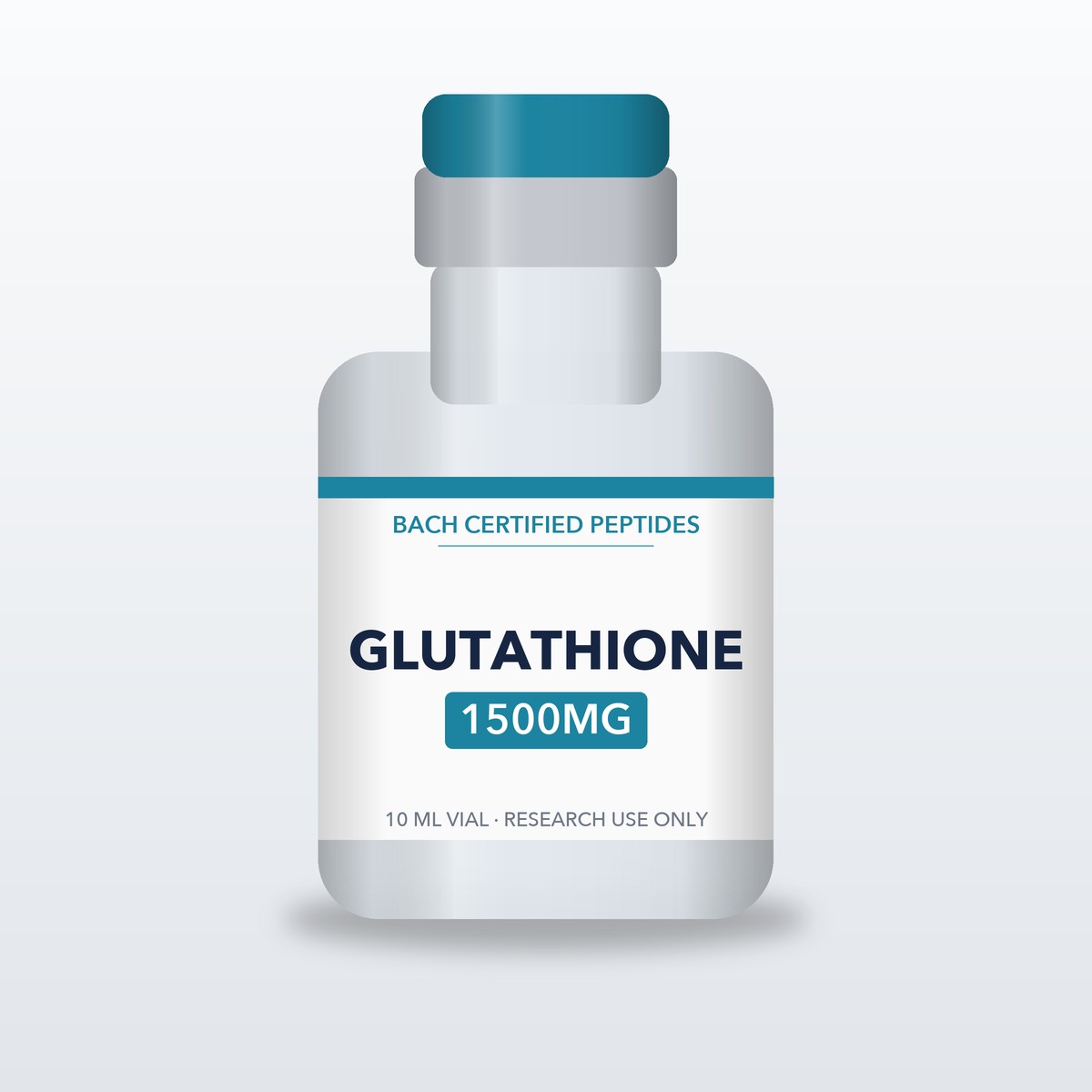
| GLUTATHIONE 1500MG | |
|---|---|
| SKU | CP_GLUTATHIONE_1500MG_10ML_VIAL |
| CATEGORY | Research Compounds |
| CAS | 70-18-8 |
| VIAL SIZE | 10 mL |
| FORM | LYOPHILIZED POWDER |
| MOLECULAR WEIGHT | 307.32 g/mol |
| SEQUENCE | gamma-Glu-Cys-Gly |
| MOLECULAR FORMULA | C10H17N3O6S |
| ITEM ID | 4225 |
Glutathione is one of the most extensively studied low-molecular-weight thiols in cell biology. In its reduced form (GSH), it serves as a substrate for glutathione peroxidases and glutathione S-transferases and participates in maintaining intracellular redox balance. The GSH/GSSG ratio is a widely used indicator of cellular redox status in experimental models. Glutathione is involved in numerous biochemical pathways including thiol-disulfide exchange, xenobiotic conjugation, and iron-sulfur cluster metabolism.
Glutathione 1500mg for laboratory research
L-glutathione is a tripeptide made of three amino acids: glutamate, cysteine and glycine. It is found in nearly every cell in the body and is the most abundant of the small antioxidants inside cells, kept at millimolar concentrations [1]. Levels in plasma are far lower than inside cells. This vial holds 1500 mg of reduced glutathione (GSH) as material for laboratory research. It is supplied for research purposes, including research and educational purposes, only. It is not for human consumption or veterinary use, and it is not a food, vitamin or one of the supplements sold for human use.
L-glutathione structure and glutathione metabolism
Glutathione has an unusual first bond. Glutamate links to cysteine through its side-chain (gamma) carboxyl group, which protects the molecule from most peptidases. Cells build it in two steps: glutamate-cysteine ligase joins glutamate and cysteine, and glutathione synthetase adds glycine [2]. Cysteine supply usually limits the rate, and glutamine feeds the glutamate side of the pathway, so glutathione metabolism is tied closely to amino acid metabolism.
How glutathione helps neutralize reactive oxygen species
The free thiol on cysteine is what lets glutathione neutralize reactive oxygen species. Reduced glutathione donates electrons to peroxides and free radicals, and two molecules then join through a disulfide bond to form the oxidized form, GSSG. Glutathione reductase converts GSSG back to GSH using NADPH [1]. The GSH to GSSG ratio is one of the most common readouts of cellular redox state and oxidative stress, and researchers use it as a baseline before and after an experimental challenge.
Glutathione enzymes and detoxification pathways
Several enzyme families depend on glutathione. Glutathione peroxidases use it to break down hydrogen peroxide and lipid peroxides. Glutathione also binds cysteines on proteins under oxidative stress. Glutathione S-transferases attach it to reactive compounds so cells can export them, the core of the detoxification pathways studied in the liver [1]. That role in liver detoxification is why liver cells and liver tissue are among the most common models in glutathione research.
Glutathione, immune function and ferroptosis
Glutathione also appears in immune function research. Immune cells find a reduced glutathione pool essential to proliferate and respond during infection, and many bacteria make their own glutathione, which complicates infection models. Researchers studying immune resilience or inflammation often track glutathione levels alongside other markers.
Glutathione is also central to ferroptosis, an iron-dependent form of cell death. Yang et al. (2014) showed that the enzyme GPX4, which needs glutathione to work, controls whether cancer cell lines undergo ferroptosis [3]. When glutathione runs out, lipid peroxides build up and cells die. Older work in rats even identified oxidized glutathione as one of several sleep-promoting substances in the brain [4], a reminder of how many aspects of cell biology the molecule is linked to.
What is still unknown
Most of what is known about glutathione comes from cell biology and animal studies conducted under controlled conditions. In animal studies where glutathione was administered directly, much of it was broken down outside cells by gamma-glutamyl transferase. Results observed in cells don’t establish efficacy, health effects or adverse effects in people, and this page makes no claims about disease, treatment or recovery. Glutathione is not FDA approved for any use as sold here, and it hasn’t been evaluated for any purpose beyond research.
Purity, storage and experimental design
Certified Peptides manufactures in a cGMP facility in Texas. Every batch is tested by an ISO/IEC 17025 accredited US lab for purity (HPLC), quantity, identity (LC-MS), endotoxins, heavy metals and sterility. Match the QR-coded lot on your vial to its report in the COA Library, and see Lab Testing for the full panel. When you buy Glutathione 1500mg from us, the COA also lets you confirm GSH purity before you start.
Glutathione is water soluble, and in solution it oxidizes in air, an effect sped up by light and trace metal ions in the environment. To maintain molecular integrity during storage, store the vial sealed, dry, cold and away from light. Lyophilized material can cling to the vial wall, so check that all of it is accounted for in your weighing. For experimental design, prepare fresh solutions, record the time between preparation and use, and include GSH and GSSG standards when determining redox ratios. These steps assist with reproducibility across protocols.
Related redox research compounds include NAD+ 500mg, whose reduced partner NADPH regenerates glutathione, and MITO BLEND 120MG.
Questions researchers ask
What is the difference between GSH and GSSG?
GSH is reduced glutathione, a single tripeptide with a free thiol group. GSSG is the oxidized form, two GSH molecules joined by a disulfide bond after they have neutralized an oxidant. This vial contains GSH, and its purity result should be checked for GSSG content.
Why does the gamma bond in glutathione matter?
Most peptidases cut standard alpha peptide bonds, so the gamma-glutamyl bond makes glutathione resistant to them. Only a few enzymes, mainly gamma-glutamyl transferase on the cell surface, can break it. That stability is part of why cells can keep such high glutathione levels.
How do researchers measure the GSH to GSSG ratio?
Common methods include HPLC, LC-MS and enzyme-recycling assays based on glutathione reductase. GSH oxidizes quickly once a sample is taken, so labs usually block the thiol group with a capping agent during extraction. Without that step, measured GSSG can be artificially high.
Why does glutathione oxidize in solution?
The free thiol on cysteine reacts with oxygen, and trace metals such as copper and iron speed the reaction. Oxidation is faster at neutral and alkaline pH than in acidic solutions. Preparing solutions fresh, keeping them cold and using metal-free buffers slows the conversion to GSSG.
How does glutathione relate to NADPH?
Glutathione reductase uses NADPH to turn GSSG back into GSH [1]. That links glutathione levels to the pentose phosphate pathway, the main source of NADPH in many cells. Cells short on NADPH can’t keep their glutathione pool reduced.
Why is cysteine the limiting amino acid?
Of the three amino acids in glutathione, cysteine is usually present at the lowest levels in cells. Its supply sets how fast glutamate-cysteine ligase can work, so it controls the rate of synthesis [2]. That is why cysteine precursors are a common way to raise glutathione in cell models.
Disclaimer
For laboratory research use only. Not for human or veterinary use. Not for consumption. This product is not a drug, food or cosmetic. Information on this page is for educational purposes, has not been evaluated by the FDA, and is not intended to diagnose, treat, cure or prevent any disease.
References
- Forman HJ, Zhang H, Rinna A. “Glutathione: overview of its protective roles, measurement, and biosynthesis.” Mol Aspects Med. 2009;30(1-2):1-12. PubMed
- Lu SC. “Glutathione synthesis.” Biochim Biophys Acta. 2013;1830(5):3143-3153. PubMed
- Yang WS et al. “Regulation of ferroptotic cancer cell death by GPX4.” Cell. 2014;156(1-2):317-331. doi:10.1016/j.cell.2013.12.010
- Honda K, Komoda Y, Inoué S. “Oxidized glutathione regulates physiological sleep in unrestrained rats.” Brain Res. 1994;636(2):253-258. PubMed


Reviews
There are no reviews yet.